 EN
EN ES
ES DE
DE FR
FR NL
NL IT
IT JA
JA PT
PT PL
PL KO
KO
How to Scan Documents for Broken Links — ReplaceMagic Guide
Scanning is the first step in any broken link repair project. ReplaceMagic crawls every document in your chosen location — local folders, network shares or SharePoint — and builds a complete inventory of every embedded link and its current status. No documents are opened or modified during a scan.
What Scanning Does
A scan reads every document in your target location and catalogues all embedded links. For each link it records:
- The document it was found in
- The link type (hyperlink, OLE, link source, Power Query etc.)
- The current link value (the path or URL)
- Whether the link is valid or broken (if validation is enabled)
- The document area where it was found (header, body, VBA etc.)
- Document metadata (size, date, file type)
Once the scan is complete you can review results, filter by broken status, export for reporting — or go straight to configuring your search/replace rules to fix the broken links.
Step-by-Step: How to Scan Documents
Step 1 — Select Your Scan Location
Open ReplaceMagic and go to the Scan Documents tab. In the bottom-right area you will see the location selection controls. Choose where your documents are stored:
- Local folder or network share — enter or browse to a UNC path (e.g.
\\FileServer\Company\Documents) - SharePoint Online or on-premises — enter the SharePoint site URL and authenticate
- Multiple locations — add several folders or SharePoint libraries to scan in one run

Full guide: How to select a local or network location → | Full guide: How to select a SharePoint location →
Step 2 — Configure Scan Options
Before starting the scan, set your scanning preferences:

- Search in Subfolders — enable to crawl all subdirectories under your selected location (recommended for most migrations)
- Skip Files without Links — exclude documents that have no embedded links from the results. This makes the results list cleaner and speeds up the subsequent fix process by skipping irrelevant files
- Skip files older than? — filter documents by date to focus on recently used files first. Apply the date filter to creation date, last access date, or last modified date. Useful when you want to prioritise recently active documents and defer older ones
- File type filter — restrict the scan to specific file extensions (e.g. scan only .xlsx and .docx) rather than all supported formats
- Link validation — optionally instruct ReplaceMagic to check whether each found link actually resolves (HTTP check for web links, file existence check for file paths). Adds processing time but gives you broken/valid status for every link — essential for pre-migration audits
Step 3 — Start the Scan
Click the Scan Documents button to begin. ReplaceMagic is a multi-threaded application — it processes multiple documents in parallel across CPU cores, which means large document libraries are scanned quickly.

During the scan you will see a real-time counter showing documents processed. You can monitor progress in the Console tab. There is no need to wait — for large libraries the scan will run in the background while you review settings or prepare your search/replace rules.
Step 4 — Review the Scanning Dashboard
When the scan completes, ReplaceMagic displays a Scanning Dashboard summarising what was found. The dashboard gives you an immediate high-level view before you drill into individual results:

Overall totals: documents found, total links, broken links count

Document age breakdown by creation date — helps prioritise which documents to fix first

Link type breakdown: hyperlinks, OLE links, link sources, etc.

Broken vs valid links — the key number for migration planning
Step 5 — Review Results in the Grid
After the dashboard, the full results grid shows every document and every link found. You can:
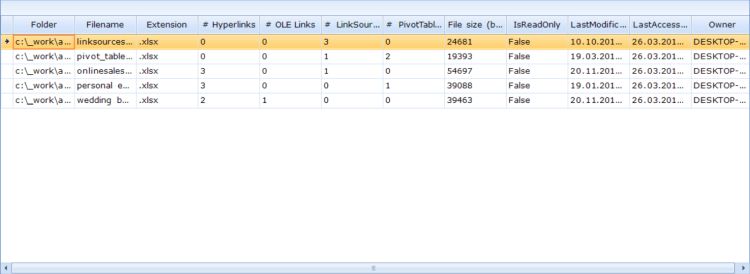
- Filter by broken/valid status, document type, link type or location
- Sort by any column (document name, link count, broken count, file size, date)
- Drill down into a document to see every individual link it contains
- Export the results to CSV, Excel or a database for stakeholder reporting
- Use as input for your search/replace rules — the scan results tell you exactly what strings need to be replaced
What to Do After Scanning
Fix Broken Links
Configure your search and replace rules, run in Preview mode to validate, then execute. See the Fix Broken Links guide.
Export for Reporting
Export results to CSV or Excel to share with stakeholders or use as a migration audit baseline. See the Export Results guide.
Import & Re-scan
Import a previously saved scan file to resume work, or re-scan after fixes to verify all links are now valid. See the Import Data guide.
Using Scanning as a Pre-Migration Audit
One of the most valuable uses of ReplaceMagic's scan feature is running an audit before a migration starts. By scanning your current document storage with link validation enabled, you get:
- A complete inventory of all documents containing embedded links
- A count of links that are already broken before migration — important for scoping the post-migration repair effort accurately
- A breakdown of link types in use, helping you choose the right ReplaceMagic edition
- An exportable baseline report for project management and stakeholder sign-off
The pre-migration scan data feeds directly into your post-migration replacement rules — the old paths you see in the scan results become the search strings in your repair run.
Scan Performance Tips
- Disable link validation if you only need to find and count links (not check whether they resolve) — this significantly speeds up the scan
- Use Ultra Fast scan mode for a pure file inventory without link content analysis — useful when you just need to know which files exist before migration
- Increase parallel processing for local or network drive targets (Configuration → Configuration tab). For SharePoint Online, keep it at 3–5 to avoid throttling
- Use date filters to scan only recently modified documents first — tackle the highest-priority files in your first run
- Split large libraries into folder-by-folder batches for very large estates (250,000+ documents per run is the recommended batch size)


